
Video Production Support Services: A Filmmaker's Guide

TL;DR:
Video production support services handle logistics and operational tasks to keep shoots on time and within budget. They cover crew sourcing, permits, locations, equipment, and post-production, enabling creative teams to focus on content rather than admin. Outsourcing these services reduces operational risks, hidden costs, and streamlines the entire production process.
Video production support services are professional logistical and operational solutions that manage crew sourcing, permits, location coordination, and post-production to keep video shoots on time and on budget. These services cover the full operational backbone of a production, freeing filmmakers and brand managers to focus on creative decisions rather than administrative fires. The industry standard term for this discipline is “production services management,” though the broader phrase captures everything from a single Unit Production Manager to a full logistics team. Videoproductionswitzerland has delivered this kind of expert film production assistance in Switzerland for over 20 years, handling the details that determine whether a shoot succeeds or stalls.
What do video production support services actually cover?
Production support covers every operational task that sits between your creative brief and the final deliverable. The scope is wider than most filmmakers expect before their first international shoot.
The core functions break down into five areas:
Crew sourcing and assembly. A qualified support provider builds your team from local networks, matching roles to budget and timeline. This includes sourcing Directors of Photography, gaffers, grips, and production assistants with verified credits.
Permit acquisition and compliance. Local filming permits vary by canton, municipality, and location type. Expert partners navigate these rules so you avoid legal delays. Navigating local insurance liabilities, tax compliance, and permit nuances is critical; expert support prevents costly last-minute production delays.
Location scouting and logistics. Support teams scout, secure, and prep locations, including access agreements, parking, and power supply arrangements.
Equipment coordination. Gear sourcing, transport, and on-set technical support fall under this umbrella, reducing the risk of equipment failures derailing shoot days.
Post-production support. This includes video editing services, color grading, sound design, and delivery formatting. Specialized providers deploy production teams within 48–72 hours, with post-production turnaround between 24–72 hours. That speed matters when client deadlines are fixed.
Pro Tip: Lock in your permits and crew bookings at least three weeks before your shoot date. Last-minute permit applications in cities like Zurich or Geneva routinely take longer than expected, and a delayed permit can push your entire schedule back by days.
The most overlooked area is pre-production paperwork. Standardizing call sheets, deal memos, and risk assessments before the shoot eliminates on-set confusion and keeps communication centralized. Decentralized communication is the single most common cause of shoot-day chaos.

How are production support services structured and staffed?
The staffing hierarchy in production support follows a clear chain of command. Understanding it helps you know exactly who is responsible for what on your shoot.
The three key roles are:
Unit Production Manager (UPM). The UPM owns budget oversight and legal compliance. This person signs off on vendor contracts, manages the production account, and reports directly to the producer.
Production Coordinator (PC). The PC handles daily logistics: crew travel, accommodation, call sheets, and vendor communication. This role is the operational hub of any shoot.
Production Assistants (PAs). The Production Assistant role is an essential tactical position responsible for set safety and communication. Proper vetting is vital for smooth operations. PAs are not errand runners; they are the connective tissue between departments.
Consolidating the UPM and PC roles reduces overhead by 20–30% on smaller productions. That saving is significant on a tight budget and explains why many brand managers choose consolidated service models for commercial shoots.
Production support providers typically offer three engagement models:
Model | Best for | Pricing basis |
Full-service | Large international shoots | Project complexity |
Plug-in | Productions with partial in-house teams | Specific gap coverage |
À la carte | Small or single-day shoots | Individual task rates |
These three flexible models allow clients to match their spend to their actual needs rather than paying for services they already have in-house.
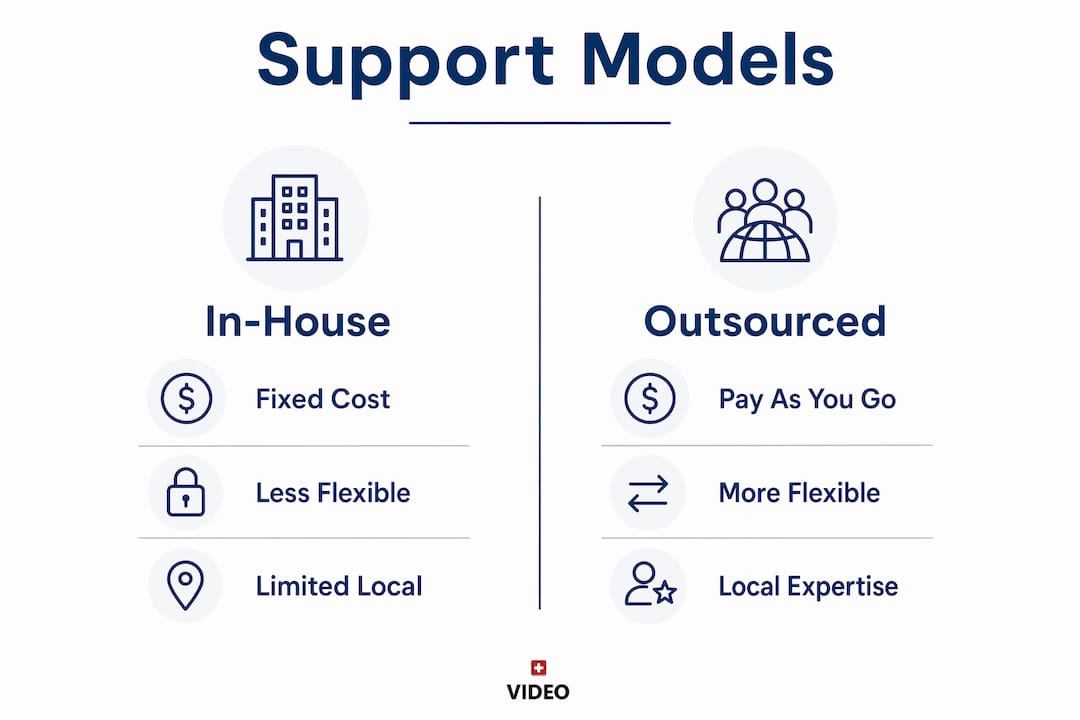
Pro Tip: If you already have a strong creative team but lack local logistical knowledge, the plug-in model is almost always the most cost-effective choice. You keep your existing crew and add local expertise exactly where the gaps are.
For a deeper look at how the production coordinator role drives efficiency, the post-production coordinator breakdown on Videoproductionswitzerland covers the responsibilities in detail.
What are the benefits of outsourcing versus managing in-house?
Operational risk mitigation, not resource scarcity, is the primary reason productions partner with third-party support providers. That distinction matters because it reframes the decision from “can we afford this?” to “can we afford not to?”
The concrete benefits include:
Local network access. Third-party providers bring established relationships with permit offices, equipment rental houses, and location owners. Leveraging local network relationships mitigates permitting, insurance, and equipment logistics risks that outside teams simply cannot anticipate.
Hidden cost elimination. Permit fees, insurance riders, and equipment transport costs are predictable when managed by an experienced partner. Unmanaged, these costs routinely exceed initial estimates by a wide margin.
Consistent quality in post-production. Freelance-dependent post-production models often lead to inconsistency and long revision cycles. A dedicated team model reduces time-to-first-cut and maintains brand alignment across deliverables.
Rapid resource scaling. When a shoot expands or a crew member drops out, a support provider fills the gap within 48–72 hours. An in-house team managing an unfamiliar market cannot match that response time.
Creative throughput gains. Even small-scale productions benefit from professional production support, doubling creative throughput by preventing logistical bottlenecks. When your director is not chasing permits, they are directing.
The financial case is clearest on international shoots. A brand manager sending a crew to Switzerland for the first time faces unknown permit jurisdictions, local labor laws, and equipment import rules. An experienced local partner converts those unknowns into fixed, manageable line items.
How to integrate production support into your project workflow
Integrating media production support into your workflow requires decisions at three stages: before you book anything, during pre-production, and on shoot day.
Define your service model first. Assess your in-house capabilities honestly. List every operational task your team cannot handle confidently, then match that list to a full-service, plug-in, or à la carte provider. This single step prevents overspending and under-resourcing.
Centralize all project communication. Use a single project management tool, whether that is a production portal, a shared drive, or a platform like Trello, to house call sheets, deal memos, and location agreements. Centralized documentation eliminates confusion and keeps every department aligned. Never run a multi-day shoot across email threads and text messages.
Set permit and crew booking deadlines early. Build your production timeline backward from the shoot date. Assign permit applications a deadline at least three weeks out. Confirm crew bookings two weeks before. Lock equipment at least one week before. Late bookings in unfamiliar markets cost more and deliver less.
Vet your production assistants through local networks. Hiring PAs through local film network portals gives you access to candidates with verified on-set experience. A PA hired through a personal referral in an unfamiliar city is a gamble. A PA sourced through a credentialed local network is a known quantity.
Plan post-production before the shoot starts. Agree on delivery formats, revision rounds, and turnaround expectations with your video editing services provider before day one. Productions that treat post-production as an afterthought consistently miss client deadlines.
For practical strategies on keeping costs under control while managing these steps, the cost reduction guide on Videoproductionswitzerland offers specific approaches for media teams.
Pro Tip: Build a one-page production brief that covers location, shoot dates, crew size, permit requirements, and post-production deliverables. Share it with your support provider on day one. It cuts briefing time in half and prevents scope creep.
Key Takeaways
Effective video production support services reduce operational risk, control hidden costs, and free creative teams to focus on the work that actually matters.
Point | Details |
Core scope is wider than expected | Support covers crew, permits, locations, equipment, and post-production, not just logistics. |
Three service models exist | Full-service, plug-in, and à la carte models let you match spend to actual project needs. |
Role consolidation saves money | Combining UPM and PC functions reduces overhead by 20–30% on smaller productions. |
Outsourcing mitigates real risk | Local partners prevent permit delays, insurance gaps, and equipment failures before they happen. |
Post-production needs early planning | Agreeing on formats and turnaround times before the shoot prevents missed client deadlines. |
What I’ve learned after years of watching productions get logistics wrong
The conventional wisdom says production support is a luxury for big-budget shoots. That is wrong. The productions I have seen struggle most are mid-size commercial shoots where the brand manager assumed their in-house marketing team could handle logistics in an unfamiliar country. They cannot, and the cost of finding that out on shoot day is brutal.
The most underrated part of this work is permit management. Filmmakers routinely underestimate how jurisdiction-specific permit rules are. In Switzerland alone, the rules differ between cantons, between urban and rural locations, and between public and private land. A team that has navigated those rules hundreds of times is not a nice-to-have. It is the difference between a shoot that runs and one that gets shut down.
I have also watched the freelance post-production model fail repeatedly. A single freelance editor working in isolation produces inconsistent results across a campaign. A dedicated team with shared brand guidelines and a defined revision process delivers the same quality on deliverable one and deliverable ten. The speed difference is real, and the revision cycle difference is even more significant.
The future of this field is consolidation. Productions are moving toward single-partner models that cover everything from the first location scout to the final export. That shift makes sense. Every handoff between vendors is a point of failure. Fewer handoffs mean fewer problems.
— Pieter
How Videoproductionswitzerland supports your production in Switzerland
Videoproductionswitzerland provides full-service production support for international filmmakers and brand managers shooting in Switzerland.
[
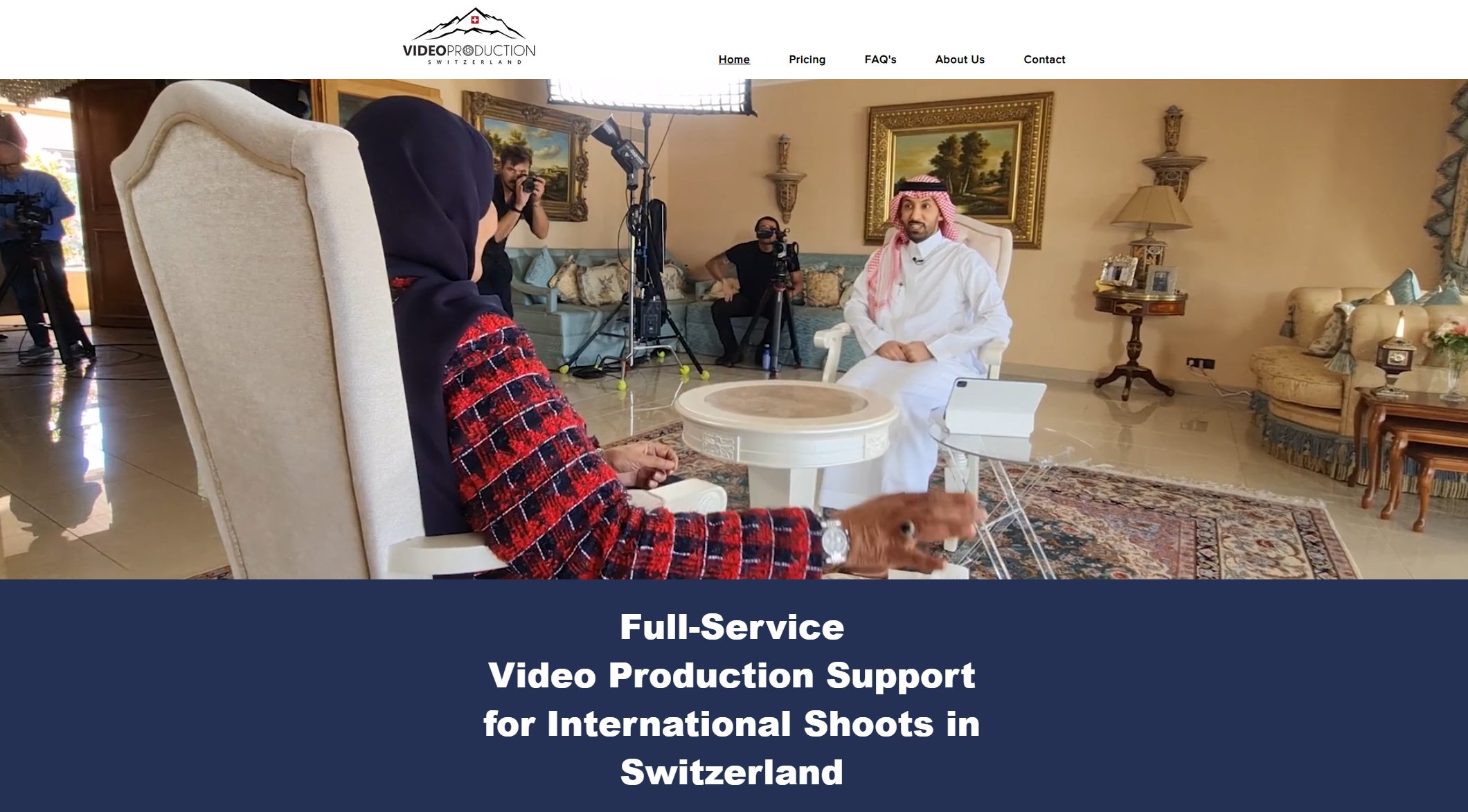
The team handles permit acquisition across Swiss cantons, sources trusted local crew, scouts and secures locations, and manages equipment logistics from arrival to wrap. With over 20 years of experience in the Swiss market, Videoproductionswitzerland takes the operational weight off your team so your creative leads can stay focused on the work. Whether you need end-to-end management or targeted plug-in support, the process starts with a free consultation. Reach out through videoproductionswitzerland.com to discuss your project and get a clear picture of what full-service Swiss production support looks like in practice.
FAQ
What do video production support services include?
Video production support services cover crew sourcing, permit acquisition, location management, equipment logistics, and post-production services including video editing and delivery. The exact scope depends on the service model selected.
How quickly can a production support team be deployed?
Specialized providers typically deploy production teams within 48–72 hours, with post-production turnaround between 24–72 hours for standard deliverables.
What is the difference between a UPM and a Production Coordinator?
The Unit Production Manager oversees budget and legal compliance, while the Production Coordinator manages daily logistics and crew travel. Consolidating both roles reduces overhead by 20–30% on smaller productions.
When should a brand manager use third-party production support?
Third-party support is most valuable when shooting in an unfamiliar location, managing permit-heavy environments, or when the in-house team lacks local network relationships for crew and equipment sourcing.
How does post-production support differ from freelance video editing services?
A dedicated post-production team maintains consistent brand alignment and faster revision cycles compared to freelance editors. Freelance-dependent models frequently produce inconsistent results and longer time-to-first-cut across multi-deliverable campaigns.
Recommended
