
Video Production Sustainability: Strategies That Actually Work


TL;DR:
Most big-budget film productions emit around 3,370 metric tons of CO2, mainly from fuel and generators.
Implementing sustainable practices early, such as using LED lighting and virtual production, can significantly reduce emissions and costs.
Most filmmakers know that a single big-budget production generates roughly 3,370 metric tons of CO2 over its entire shoot. That number stops most people cold. What stops them longer is the assumption that fixing it requires a bigger budget, a slower schedule, and a production manager willing to fight every department head on every decision. That assumption is wrong. Video production sustainability, when built into your process from day one, often costs less than the conventional approach and creates a smoother shoot in the process. This guide breaks down exactly how to make that happen.
Table of Contents
Key Takeaways
Point | Details |
Measure before you cut | Identify your Scope 1, 2, and 3 emissions before making any changes to know where reductions will have the most impact. |
Technology pays for itself | LED lighting and virtual production setups reduce energy costs significantly while cutting your carbon footprint. |
Start in pre-production | Embedding sustainability early prevents costly retrofitting and missed opportunities during shoot. |
Reuse drives real savings | Circular economy practices like set material reuse have saved individual productions hundreds of thousands of dollars. |
Culture change is the multiplier | Technology and tactics only work when the entire crew, not just the sustainability coordinator, owns the responsibility. |
Where video production sustainability really starts
Before you can reduce your footprint, you need to know what you are actually measuring. Most productions fail here, not because they lack motivation, but because they underestimate how spread out their emissions actually are.
The three scopes of emissions give you a practical framework. Scope 1 covers direct emissions you control: diesel generators, fuel for production vehicles, gas-powered equipment on set. Scope 2 covers purchased electricity. Scope 3, according to the Green Production Guide, covers everything upstream and downstream, including supply chain, crew travel, vendor operations, and even the digital infrastructure hosting your final files. Scope 3 is almost always the largest category and the hardest to track.
Here is where the emissions are actually coming from across a typical production:
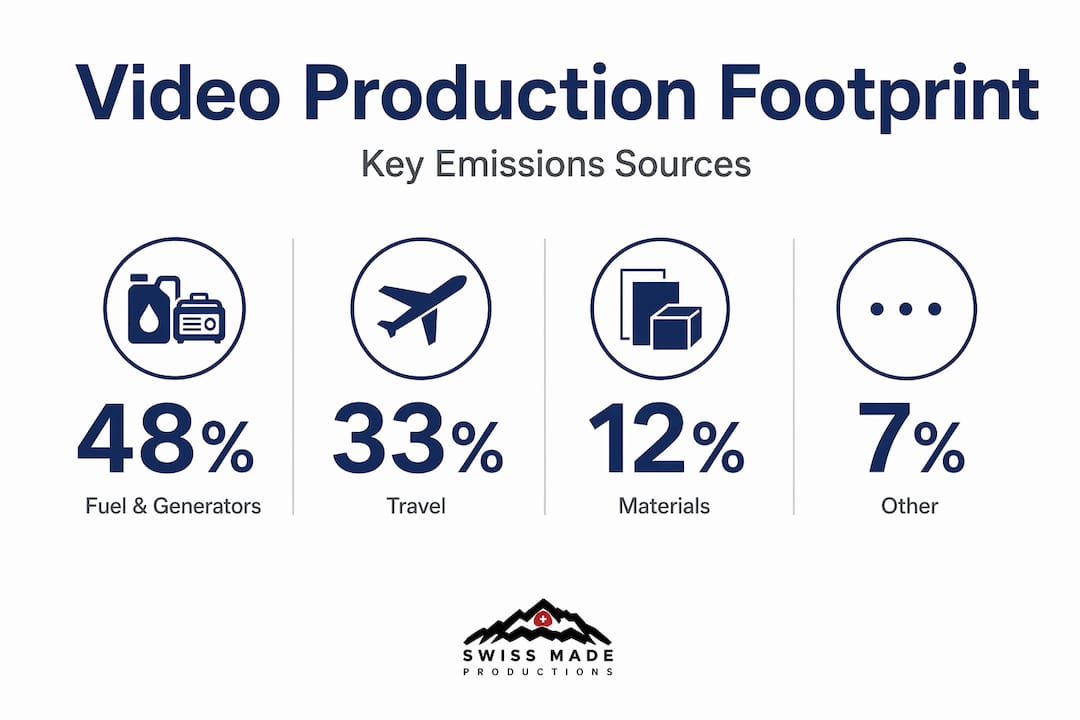
Fuel and generators: Fuel consumption accounts for 48 to 56% of a production’s total carbon footprint. Diesel generators are the single largest contributor.
Transportation: Crew vehicles, production trucks, and freight shipments pile up fast, especially on location shoots.
Set construction: Lumber, paint, adhesives, and single-use materials add up in both carbon and landfill weight.
Accommodations: Hotels for large crews over multi-week shoots carry a measurable footprint, particularly if located far from sustainable energy grids.
Digital footprint: Cloud storage, render farms, and video review platforms collectively consume significant electricity.
Tracking all of this requires deliberate systems. Carbon calculators built for the film industry, like those available through the Green Production Guide, can get you to a reliable baseline faster than building your own spreadsheet from scratch.
Emission source | Typical share of footprint | Reduction priority |
Fuel and generators | 48 to 56% | High |
Transportation | 15 to 25% | High |
Electricity use | 6 to 15% | Medium |
Set construction | 8 to 12% | Medium |
Catering and accommodation | 5 to 10% | Lower |
Sustainable technologies that make a measurable difference
Once you know where your emissions come from, the technology choices become much more obvious. The good news is that the most impactful tools are already widely available.
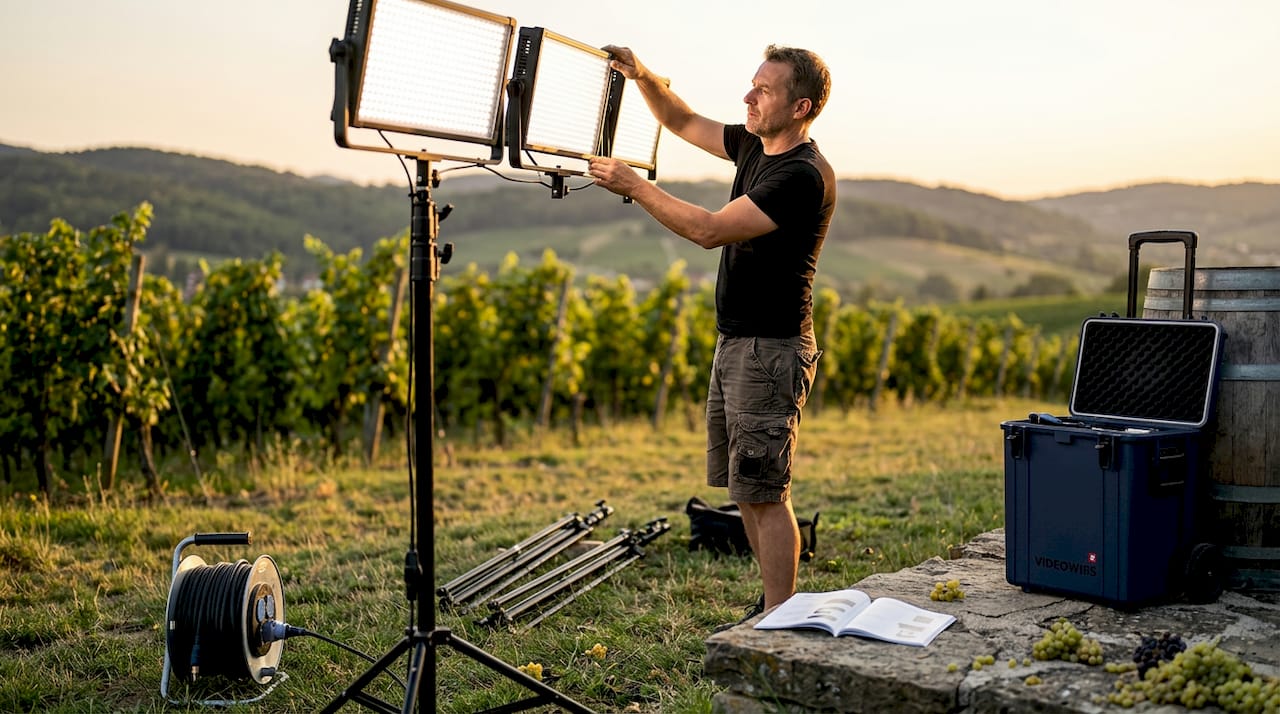
LED lighting is the clearest win. LED fixtures use up to 75% less energy than traditional tungsten or HMI alternatives, and modern LED panels now match or exceed the color accuracy that demanding cinematographers require. Switching your lighting package is often budget-neutral over a shoot of any significant length once you factor in reduced generator load and lower fuel costs.
Virtual production deserves more attention than it gets in sustainability conversations. By replacing physical location shoots with LED volume stages, you eliminate flights, freight, fuel, and lodging for entire shooting days. Virtual production reduces emissions by 20 to 80% depending on how many location days it replaces. That range sounds wide, but even the conservative end represents a transformation in your production’s footprint.
Power sourcing is where many productions leave the most unrealized savings. Replacing diesel generators with solar hybrid units, battery storage systems, or direct grid connections where locations permit can slash Scope 1 emissions dramatically. Electric and hybrid crew vehicles reduce transport emissions further, and many major cities now have rental fleets specifically configured for productions.
Solar hybrid generator units can power lighting and basecamp equipment on exterior locations without diesel.
Electric shuttle vehicles for crew transport reduce per-person emissions on multi-day shoots.
Modular set design reduces material consumption by making pieces reusable across multiple productions.
Material reuse programs coordinated through prop houses and set dec vendors create circular supply chains without extra cost.
Pro Tip: When scouting locations, add one specific question to your assessment: can this location connect directly to grid power? The answer shapes your entire generator strategy before you have committed to anything.
You can find more specific guidance on reducing your production footprint at every stage, from pre-light through wrap.
The business case for going green on set
Sustainability advocates often make the mistake of leading with the environmental argument when the financial argument is just as strong. For production companies and brand managers managing budgets, cost matters.
Consider what material reuse delivered on The Amazing Spider-Man 2: over $400,000 in savings from circular economy practices applied to set construction. That is not a rounding error. That is real money that came directly from treating set materials as assets instead of single-use expenses.
Here is how to build the financial case for your own productions:
Calculate your generator fuel spend. On a 30-day shoot, diesel costs for a mid-sized production can reach $50,000 to $100,000. Solar hybrid alternatives often reduce this by 40 to 60%.
Price out material reuse versus purchase. Work with a prop house or set dec rental company to compare the cost of buying versus renting and returning. The difference is often significant, especially for set dressing you will never use again.
Account for waste disposal savings. Sustainable waste management through diversion and composting typically costs less than landfill disposal at scale.
Factor in brand value. For brand managers specifically, documentable sustainability practices carry increasing weight with clients, agencies, and end audiences who expect ethical media production.
Early integration of sustainability in pre-production is what makes all of this financially viable. Retrofitting sustainability mid-shoot, or worse, trying to add it during post, wastes time and money that could have been avoided entirely with better planning. The schedule impact of sustainable practices drops to near zero when they are designed in from the start.
Pro Tip: Include a line in your pre-production budget specifically for a sustainability assessment. Even a one-day consultation with a green production specialist during prep can identify savings that far exceed the consultation fee.
Embedding sustainability as a culture, not a checklist
Technology and budgets are not the long-term challenge. Culture is. The productions that achieve lasting results are the ones where the grip and the director both understand why it matters, not just the sustainability coordinator.
The Producers Guild Sustainability Toolkit puts this plainly: sustainability needs to function as an operating system embedded across every phase of production, from development through post and marketing. When it lives only in one department, it creates friction. When it is shared across the entire crew, it becomes a professional standard.
“Sustainability efforts often stumble not due to poor strategy but incomplete systemic integration. Embedding sustainability as an operating system ensures lasting impact.” — Producers Guild of America
Building that culture requires a few specific commitments:
Normalize sustainable behavior on screen. Storytelling choices that reflect environmental awareness, even subtly, shift audience expectations over time.
Engage unions and guilds early. Some of the most effective sustainability initiatives have come from labor agreements that standardized green practices across productions.
Create accountability through reporting. If you track it and share it, crews take it seriously. Publish your production’s carbon report.
Prepare for regulation. California’s new climate disclosure laws now require studios to report emissions across their supply chains, which means your production may soon be part of a mandatory disclosure.
The cultural shift is slower than swapping in LED panels. It requires leadership to model the behavior, and it requires everyone from craft services to the executive producer to see themselves as part of the solution.
Practical first steps you can take this week
Most productions that want to improve their sustainability practices do not know where to start. Here is a practical path that requires no major budget commitment.
Digital workflows are the easiest entry point. Tools like Scriptation and Scenechronize eliminate paper script distribution entirely. Moving call sheets, production reports, and contracts to digital-first systems takes a week to implement and reduces paper consumption to nearly zero.
Catering is the next most accessible area. Sustainable catering practices, including local sourcing, plant-based meal options, and eliminating single-use plastics from craft services, can be implemented for the same or lower cost than conventional catering on most productions.
Beyond that, here is a comparison of where to put your effort depending on your production scale:
Production scale | Highest-impact first step | Resource to use |
Small (under $500K) | Digital workflows and sustainable catering | Green Production Guide |
Mid-size ($500K to $5M) | Generator replacement and material reuse | Eco-manager or sustainability consultant |
Large ($5M and above) | Scope 3 tracking and virtual production integration | Producers Guild Sustainability Toolkit |
Working with an experienced eco-friendly production partner means you do not have to build these systems from scratch. Local production service companies with sustainability experience can often source green-certified vendors, arrange electric vehicle fleets, and identify grid-connected locations before you even land.
My honest take on why most productions still get this wrong
I have watched many productions launch sustainability initiatives with real conviction and still end up with the same footprint they started with. The reason is almost never technology. It is culture and timing.
What I have seen consistently is this: sustainability gets assigned to one person, late in pre-production, after all the major decisions have already been made. The locations are booked. The generator vendor is contracted. The set construction plan is finalized. At that point, the “green coordinator” is managing optics, not outcomes.
What actually works is treating sustainability the way you treat safety. No one puts safety in charge of one junior department head and forgets about it. Safety is a shared responsibility with leadership accountability, budget, and consequences. Sustainability requires the same structure.
In my experience, the productions that have made genuine progress share one trait: the director or executive producer made a specific public commitment in the first production meeting and backed it up with resources. That single act changed the dynamic for every department that followed.
The other thing I would push back on is the idea that Switzerland or any specific filming location limits your options. The infrastructure here for electric vehicles, clean energy sourcing, and sustainable vendors is genuinely strong. The barrier is almost never the location. It is the willingness to ask the right questions before you arrive.
Sustainability in film is not an obligation you meet. It is an opportunity to run a tighter, smarter, more accountable production. The teams that figure that out early have a meaningful advantage.
— Pieter
Plan your sustainable Swiss shoot with confidence
[

If you are planning a shoot in Switzerland and want to build sustainability into the production from the start, Videoproductionswitzerland has the local expertise and vendor relationships to make it happen without adding complexity to your schedule. From sourcing grid-connected locations to arranging electric crew transport and eco-certified vendors, the team handles the logistics so your production runs on time and on values. You can review transparent production cost breakdowns to understand how sustainable choices affect your budget, or reach out through the main service page for a free consultation tailored to your project.
FAQ
What is the carbon footprint of a typical video production?
Big-budget productions generate approximately 3,370 metric tons of CO2 per project, with fuel and diesel generators accounting for nearly half of that total. Smaller commercial and branded productions emit significantly less, but the proportional sources remain similar.
Does sustainable video production cost more?
Not when planned from the start. Early integration of sustainability in pre-production avoids the cost and inefficiency of retrofitting, and circular economy practices like set material reuse have saved major productions over $400,000 on a single project.
What are Scope 1, 2, and 3 emissions in film production?
Scope 1 covers direct emissions like generators and fuel. Scope 2 covers purchased electricity. Scope 3 covers supply chain and travel, which is typically the largest and hardest-to-track category, often requiring collaboration with external vendors to measure accurately.
How does virtual production reduce emissions?
By replacing physical location shoots with LED volume stages, virtual production eliminates crew flights, freight, and accommodation emissions. Depending on how many location days it replaces, it can reduce emissions by 20 to 80% compared to a conventional shoot.
Where should a production company start with sustainability?
Start with digital workflows to eliminate paper, then address catering and on-set waste. From there, focus on generator fuel reduction and material reuse. The Producers Guild Sustainability Toolkit provides a phased framework you can apply at any production scale.
Recommended
