
How to Manage Tight Deadlines for Hassle-Free Productions


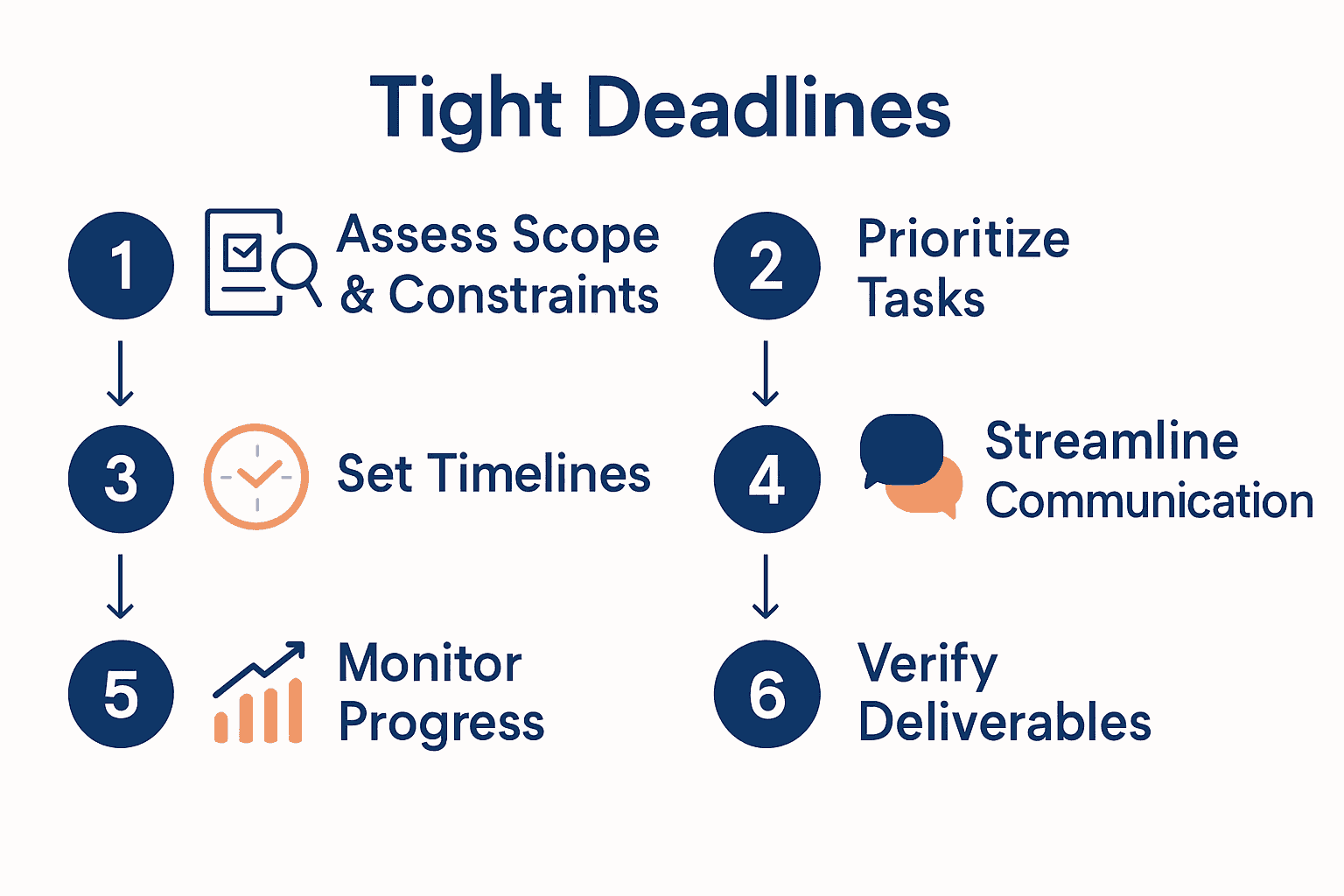
Most projects falter not from lack of ambition but from missing key steps early in the process. Studies reveal that poor planning leads to over 50 percent of project failures worldwide. Every milestone and deadline hangs on how well you define goals, assign resources, and adapt to roadblocks. Whether you’re managing a video shoot or a large-scale production, understanding these six essential project management steps will help you deliver results on time and with confidence.
Table of Contents
Quick Summary
Key Point | Explanation |
1. Define Project Scope Thoroughly | Identify objectives, constraints, and risks to establish a clear project foundation. |
2. Prioritize and Allocate Resources Wisely | Organize tasks by importance and assign skilled team members to critical activities. |
3. Set Realistic Timelines with Buffers | Break projects into milestones with built-in time flexibility to accommodate delays. |
4. Streamline Communication for Quick Decisions | Implement a centralized platform to ensure clarity and swift decision-making among team members. |
5. Establish Rigorous Quality Verification | Develop a detailed check process to ensure deliverables meet specified standards and expectations. |
Step 1: Assess Project Scope and Constraints
In this critical first step, you’ll map out the complete landscape of your project by understanding its fundamental boundaries and potential challenges. According to research from arxiv.org, developing predictive models can help you estimate potential scope changes and their impact on project cost and schedule.
Start by creating a comprehensive project charter that clearly defines your objectives, deliverables, and key constraints. As highlighted in the project management triangle from en.wikipedia.org, you must balance three core elements: scope, time, and cost. This means understanding how changes in one area will ripple across the entire project ecosystem. Break down your project into specific, measurable tasks and identify potential risks or limitations that could affect your timeline or budget.
Pro tip: Always build a small buffer into your initial estimates. Unexpected challenges are normal in any production, and having some flexibility will help you manage potential disruptions without derailing the entire project. By thoroughly assessing your project’s scope upfront, you set the foundation for smoother execution and more predictable outcomes.
Once you have a clear project scope defined, you’re ready to move forward with detailed planning and resource allocation.
Step 2: Prioritize Tasks and Allocate Resources
In this crucial phase, you’ll transform your project scope into a strategic roadmap by systematically organizing tasks and matching them with the right resources. As revealed by research on en.wikipedia.org, effectively managing resource availability and task dependencies is key to preventing bottlenecks and optimizing your project schedule.
Begin by creating a comprehensive task inventory and ranking them based on strategic importance, complexity, and interdependencies. Use a matrix that categorizes tasks into four quadrants: high priority and urgent, high priority but not urgent, low priority but urgent, and low priority and not urgent. This approach allows you to allocate your most skilled team members to critical path activities while ensuring that all necessary work receives appropriate attention. Drawing insights from arxiv.org, consider an economic based approach to resource management that minimizes costs and maximizes scheduling efficiency.
Pro tip: Always maintain a degree of flexibility in your resource allocation. Unexpected challenges will inevitably arise, so having team members who can shift roles or having backup resources can prevent potential project delays. By carefully prioritizing tasks and matching them with the right skills and availability, you create a robust framework that supports smooth project execution.
With your tasks prioritized and resources strategically allocated, you are now prepared to move into detailed project scheduling and implementation.
Step 3: Establish Realistic Timelines and Milestones
In this crucial stage, you will craft a detailed project roadmap that transforms your strategic vision into an actionable timeline. According to insights from en.wikipedia.org, conducting a comprehensive feasibility assessment is key to evaluating the practicality of your project and setting realistic expectations for completion.
Begin by breaking down your entire project into discrete, manageable milestones that build upon each other logically. Research from arxiv.org emphasizes the importance of understanding task hierarchy and distribution among team members while considering both financial and duration constraints. Create a visual timeline that maps out each milestone with specific start and end dates, allowing buffer time for potential unexpected challenges. Consider using a Gantt chart or project management software to track progress and interdependencies between different project stages.
Pro tip: Always build in a 15 to 20 percent time buffer for each milestone. Unexpected complexities are inevitable in any production, and having this flexibility prevents minor delays from cascading into major timeline disruptions.

Learn more about creating effective time planning sheets with our guide on time planning for shoots.
With your realistic timelines and clear milestones established, you are now prepared to move forward with confident project execution.
Step 4: Streamline Communication and Decision-Making
In this critical phase, you will establish a robust communication framework that ensures rapid decision making and minimizes project bottlenecks. Drawing insights from the en.wikipedia.org project analysis model, your goal is to proactively identify potential unknowns and create a transparent communication strategy that keeps everyone aligned and informed.
Implement a centralized communication platform that serves as a single source of truth for your entire team. Understanding team communication best practices becomes crucial in this process. As highlighted by Eliyahu Goldratt’s critical chain theory from en.wikipedia.org), effective communication is about managing resource constraints and task dependencies. Establish clear communication protocols including daily stand up meetings, real time messaging channels, and a decision tracking system that documents key choices and their rationales. Assign specific roles for communication oversight to ensure messages are transmitted quickly and accurately.
Pro tip: Create a communication hierarchy that defines who makes what decisions and when escalation is necessary. This prevents decision paralysis and ensures that team members understand their authority levels. By streamlining your communication approach, you reduce unnecessary meetings, minimize misunderstandings, and accelerate your project momentum.
With a clear communication strategy in place, you are now prepared to execute your project with enhanced coordination and efficiency.
Step 5: Monitor Progress and Adjust Plans Rapidly
In this pivotal stage, you will develop a proactive monitoring system that allows you to track project progress in real time and make swift, strategic adjustments. According to research from en.wikipedia.org, understanding and preventing scope creep is crucial to maintaining project integrity and avoiding costly delays and budget overruns.
Establish a comprehensive progress tracking mechanism that includes weekly status reports, performance metrics, and regular check-in meetings. Understanding video workflow software can be instrumental in this process. Research from hrmars.com emphasizes how skilled management directly influences a project’s scope, time, and cost constraints. Implement digital dashboards that provide real time visibility into task completion, resource utilization, and potential bottlenecks. Create clear trigger points that automatically signal when a project element requires immediate attention or course correction.
Pro tip: Develop a flexible response protocol that defines specific actions for different types of project deviations. This allows your team to react quickly and decisively without getting bogged down in unnecessary bureaucracy. By maintaining constant vigilance and being prepared to pivot efficiently, you transform potential challenges into opportunities for optimization.
With a robust monitoring and adjustment strategy in place, you are now equipped to navigate complex project landscapes with confidence and precision.
Step 6: Verify Deliverables and Ensure Quality
In this crucial final stage, you will systematically review and validate every project deliverable to guarantee they meet the highest standards of quality and precision. According to research from nou.edu.ng, clear documentation and communication are essential for ensuring deliverables align perfectly with project specifications and constraints.
Develop a comprehensive quality verification process that involves multiple layers of review and validation. Understanding team communication best practices will be instrumental in coordinating this final assessment. Drawing insights from greatcollege.edu.et, recognize that quality verification is about balancing time, cost, and scope constraints while maintaining exceptional standards. Create a detailed checklist that covers every aspect of your project deliverables including technical specifications, creative requirements, and client expectations. Implement a systematic review process that includes peer review, client feedback sessions, and objective performance metrics.
Pro tip: Establish a zero tolerance policy for mediocrity. Allocate sufficient time and resources for final revisions and refinements, understanding that the last 10 percent of work often determines 90 percent of the project’s perceived quality. By maintaining rigorous quality standards, you transform good projects into extraordinary ones.
With your deliverables thoroughly verified and quality assured, you have successfully completed a meticulously managed project that meets the highest professional standards.
Take Control of Tight Deadlines with Expert Local Support
Managing tight deadlines for hassle-free productions demands careful planning, clear communication, and rapid adjustments—exactly the challenges outlined in the article. When every milestone counts and unexpected issues threaten to delay your project, trusting a team with deep local knowledge and logistical expertise can mean the difference between stress and smooth success. Your goal is to deliver on time without sacrificing quality or burning out your crew.
Why struggle alone when top-tier support is just a click away Here at Video Production Switzerland, we specialize in handling complex logistics like permits, sourcing trusted crew and equipment, and coordinating transportation all tailored to the Swiss landscape. Our hands-on experience helps you stay flexible and responsive as your project demands evolve. Our proven process ensures your shoot stays on schedule and within scope so that you can focus on creativity rather than firefighting.

Get ahead of tight deadlines and project risks by partnering with a trusted local expert. Visit our website, explore how we streamline team communication best practices, and discover why hundreds of international filmmakers count on us for reliable, hassle-free productions. Contact us today for your free consultation and secure your shoot’s success now!
Frequently Asked Questions
How can I assess the project scope to meet tight deadlines?
To assess project scope effectively, create a project charter that defines objectives, deliverables, and constraints. Identify specific tasks and potential risks to understand how changes can impact your timeline and budget.
What strategies can I use to prioritize tasks efficiently?
Use a task prioritization matrix to categorize tasks by urgency and importance. Focus on high-priority tasks first to ensure that essential activities receive the necessary attention.
How do I establish realistic timelines for tight deadlines?
Break your project into manageable milestones with specific start and end dates while including buffer time for unexpected delays. Aim for a time buffer of 15-20% for each milestone to give yourself flexibility in the schedule.
What communication practices help streamline decision-making during production?
Implement a centralized communication platform to ensure transparency and consistency among team members. Define clear protocols for daily updates and establish a hierarchy for making quick decisions to avoid delays.
How can I monitor project progress and adjust plans effectively?
Set up a progress tracking system that includes regular status reports and digital dashboards for real-time visibility. Identify trigger points for when adjustments are needed, allowing your team to pivot quickly without bureaucratic delays.
What steps should I take to verify deliverables and ensure quality?
Create a detailed quality verification checklist that covers specifications and expectations for each deliverable. Include multiple review layers, such as peer reviews and client feedback, ensuring that all elements meet high standards before completion.
Recommended
