
On-time video shoot planning in Switzerland: Step-by-step guide

TL;DR:
Major film shoots in Switzerland often face delays due to permit issues, drone authorizations, or canton-specific rules rather than creative challenges.
Planning requires early permit applications, understanding canton-specific regulations, and running permits in parallel with location scouting and crew booking to ensure timely production.
Major film shoots in Switzerland fall behind schedule more often than most producers expect, and the culprit is almost never creative. It is the permit that did not arrive in time, the drone authorization that nobody budgeted lead time for, or the canton-specific rule that caught the production off guard at 7 a.m. on shoot day. If you are planning an international production here, the good news is that these delays are entirely preventable. This guide walks you through every critical stage, from permit applications to buffer scheduling, so your crew hits every call time and your shoot wraps on time.
Table of Contents
Key Takeaways
Point | Details |
Apply early for permits | Start permit applications 6-8 weeks in advance to avoid last-minute delays. |
Build in scheduling buffers | Always allow extra time for regulatory processes, weather, and logistics in Switzerland. |
Engage local film commissions | Contact film commissions for free support on permits and logistics; use private fixers only for urgent schedules. |
Understand drone rules | Add 2-4 weeks for drone permits and follow Swiss city-specific requirements closely. |
What you need to know before you start
With the challenges clear, let us lay out what information and permissions must be secured before planning can begin.
Switzerland is a federally structured country, which means filming rules vary significantly from canton to canton. What works in Geneva may not apply in Valais, and what is standard in Basel could differ entirely from the rules in Lucerne. Before you book a single location, you need to know exactly which cantonal authority governs your shoot.
Film permit processing times range from 10 days in Zurich to 1 to 3 weeks across Switzerland more broadly. Drone permits add another 2 to 4 weeks on top of that. The firm recommendation is to apply at least 6 to 8 weeks in advance to absorb any processing delays without disrupting your schedule.
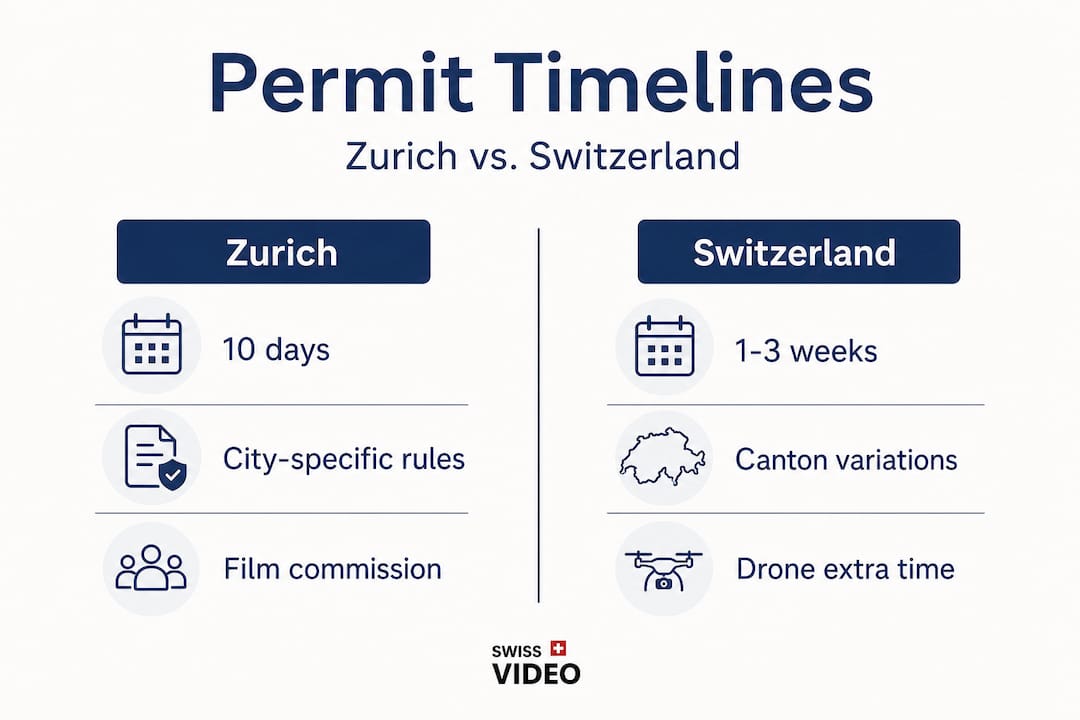
In Zurich specifically, permits are required for shoots longer than 1 hour, crews larger than 5 people, or productions that use public infrastructure such as streets, bridges, or plazas. Smaller shoots with fewer than 5 crew members and a run time under 60 minutes with minimal gear typically do not require a permit. But the moment you cross any of those thresholds, you need to apply. Understanding how to get a film permit in Switzerland is the single most important pre-production step for international crews.
Here is a quick reference of permit-related requirements before you plan a Swiss shoot:
Permit factor | Detail |
Standard processing time (Zurich) | 10 business days |
Standard processing time (Switzerland-wide) | 1 to 3 weeks |
Drone permit additional lead time | 2 to 4 weeks |
Recommended advance application window | 6 to 8 weeks |
Zurich permit threshold (crew size) | More than 5 people |
Zurich permit threshold (duration) | More than 1 hour |
Key considerations before your permit application:
Know your canton. Each canton has its own film office or authority. Do not assume rules transfer across borders.
Decide on drones early. If aerial footage is on your shot list, begin the drone authorization process the moment your shoot date is confirmed.
Identify public space usage. Any use of streets, parks, squares, or transport infrastructure triggers permit requirements in most cantons.
Account for special permissions. Traffic control, pyrotechnics, and large lighting rigs each require separate permissions in most jurisdictions.
Check for local holidays. Swiss cantonal holidays are not always nationally observed, and they can freeze government offices for several days.
Pro Tip: Do not wait for a locked script before starting permit conversations. Contact the local film commission as early as possible with your approximate shoot dates and locations. Even a preliminary inquiry puts you in the queue and often generates a faster, more informed response.
Good Swiss film shoot time management starts at this research stage, not on the day of the shoot.
Step-by-step roadmap for on-time shoot planning
Armed with the essentials, let us map out the step-by-step process that keeps your production on track.
The most common mistake international productions make is treating permitting as a parallel task rather than the critical path item it actually is. Every other production milestone should be scheduled around permit timelines, not the other way around. Here is the structured roadmap we recommend for video shoot step-by-step planning:
Confirm shoot dates and locations. Lock your primary and backup locations before anything else. Vague shoot windows make permit applications far harder to process.
Identify all regulatory requirements. Check which cantons are involved, whether drones are needed, and whether public spaces require infrastructure permits.
Submit permit applications immediately. Do not wait for full creative sign-off. Submit based on your planned locations and format.
Scout locations with a local fixer or production manager. On-the-ground scouting reveals access constraints, sound issues, and logistical challenges that photos never show.
Book crew and equipment. Finalize your crew roster and lock in equipment rentals once permits are in progress. Do not book equipment before you have a realistic sense of permit approval timelines.
Arrange logistics. Secure transportation routes, confirm vehicle access to locations, and arrange accommodation for out-of-town crew.
Set internal permit approval milestone. Build in a clear checkpoint, ideally 2 weeks before the shoot, by which all permits must be confirmed. If they are not, trigger contingency options.
Execute the shoot with confirmed permits in hand. Never begin shooting without written confirmation of all permits. Verbal assurances from location owners are not sufficient.
Wrap and debrief. Document what worked and what caused delays for future production planning.
Here is a comparison of working with a film commission versus hiring a private fixer, which is an independent local production coordinator, for permit support:
Factor | Film commission | Private fixer |
Cost | Free | Paid service |
Turnaround speed | Standard processing | Can expedite in some cases |
Local knowledge | Excellent | Varies by individual |
Network access | Broad and official | Often strong but unofficial |
Best for | Standard timelines (6 to 8 weeks) | Tight deadlines or complex shoots |
Reliability | Consistent | Depends on individual |
The Zurich Film Commission handles 600+ productions per year and offers free support for both permits and logistics. That is an exceptional resource, and international productions routinely underuse it. Engage them early and treat them as an extension of your production team.
Pro Tip: Ask the film commission for their latest deadlines calendar during your first call. Processing windows shift due to staff capacity, local events, and seasonal demand. The calendar they use internally is far more accurate than any general guideline you will find online. Pair this with scheduling to prevent shoot delays and you will have a genuinely reliable production timeline.
Permits, drones, and local rules: Avoiding regulatory delays
Planning steps often stall at the regulatory stage. Here is how to clear that hurdle efficiently.
The regulatory layer of Swiss film production is where the most expensive delays happen. Productions that have everything else in order, great crew, solid gear, confirmed locations, still lose days because the permit was not filed correctly or the drone authorization arrived too late.
To recap the Zurich thresholds: a permit is required for shoots longer than 1 hour, for crews with more than 5 people, or for shoots that use public infrastructure. Crews under 5 people with minimal gear shooting for less than 60 minutes in Zurich can typically proceed without a permit. However, this exception does not apply in every canton, so always verify locally.
Drone shoots are a special category. Beyond the standard permit timeline, drone permit approvals add 2 to 4 weeks. Switzerland has strict airspace regulations, and understanding Swiss drone regulations is non-negotiable if aerial footage is on your shot list. There are also specific drone permit rules that govern where, when, and how you can fly, and drone registration requirements that must be completed before any flight is legally authorized.
“Underestimating permit timelines is the single most common reason international productions lose shooting days in Switzerland. A two-week delay in permit approval can cascade into a full production reschedule, with accommodation, crew, and equipment costs compounding daily.”
The most common permit mistakes international crews make:
Applying too late. Applying less than 4 weeks before the shoot date almost guarantees a conflict with standard processing times.
Missing the drone window. Treating drone permits as an afterthought and applying simultaneously with standard permits, rather than 2 to 4 weeks earlier.
Assuming cantonal uniformity. Applying rules from one canton to a different shoot location in another canton without verification.
Not confirming in writing. Proceeding based on verbal or informal confirmation rather than official written permit approval.
Skipping film licensing steps. Some productions require formal licensing beyond standard location permits, particularly for commercial broadcasts or international distribution.
Ignoring infrastructure requirements. Overlooking the need to notify or gain approval from transport authorities when shooting near roads, rail infrastructure, or public transit.
Local film commissions offer free guidance on all of these issues. Engage them before you hire a private fixer unless your turnaround time is critically tight and you need someone who can navigate the process faster than standard channels allow.
Buffer strategies and time management for Swiss shoots
With permits filed, the key to on-time execution is disciplined time management and buffer planning.
Even the best permit filing strategy can be undone by an optimistic schedule. Real-world production friction in Switzerland, or anywhere else, is always higher than it looks on paper. Weather shifts unexpectedly. A cantonal holiday you did not account for closes a key office. A crew member misses a connection from a neighboring country. These are not hypothetical scenarios. They happen on real shoots, regularly.
The Zurich Film Commission’s experience handling 600+ productions annually reflects just how active this market is. That volume also means competition for permits, locations, and experienced crew is real. Your production timeline needs to reflect those market conditions.
Here are the most common time-wasters that derail Swiss shoots:
Optimistic travel estimates. Switzerland has excellent rail and road infrastructure, but mountain locations, border crossings, and equipment transport add time. Always factor in logistics buffers.
Late crew confirmations. International crews often finalize bookings too close to the shoot date, leaving no room to resolve conflicts.
Missing equipment customs documents. Importing production gear into Switzerland requires an ATA carnet (a temporary import document), and delays at customs can cost you half a shoot day.
Underestimating setup time at complex locations. Iconic Swiss locations, think mountain railways, lakeside promenades, historic old towns, often have strict setup windows and early access restrictions.
Not validating locations with local contacts. A location that looks perfect on a scout may have seasonal restrictions, private event bookings, or construction that the scout did not reveal.
Pro Tip: If you are working against an extreme deadline, consider running parallel outreach to both the local film commission and a private fixer simultaneously. Validate every milestone with a local contact who can walk the location or make a phone call on your behalf. No amount of remote coordination replaces someone on the ground. Good time management strategies for Swiss shoots always include this layer of local validation. Pairing that with the right scheduling software tools gives you visibility across every milestone and surfaces potential delays before they become crises.
Always build contingency days into your schedule for permit-heavy or multi-location shoots. One buffer day per five shoot days is a reasonable starting baseline, but complex shoots with drones or multiple cantons warrant more.
Why the best-laid film schedules fail and what actually works
Here is the hard truth: the majority of Swiss shoot delays are not caused by bad luck. They are caused by optimism. Productions enter pre-production with a best-case scenario timeline and work backward from the shoot date, filling every slot and leaving no room for the friction that Swiss production logistics reliably introduce.
Conventional wisdom says, “Apply early, confirm your permits, book your crew.” That is correct advice, but it is incomplete. What it does not tell you is to always ask for the worst-case scenario, not the average. When you call a film commission and ask how long a permit takes, the answer you receive is typically the median. Ask them explicitly: “What is the longest this has taken in the past six months?” That answer is what you should plan around.
The real-world lesson we have absorbed over two decades of Swiss productions is this: parallel outreach outperforms sequential planning every single time. Do not finish your location scout before starting permits. Do not wait for permit approval before engaging crew. Run these tracks simultaneously and build slack between each milestone. When one track runs slow, the others keep moving.
Productions that rely on a single tight plan, one that only works if every step hits its best-case timeline, are brittle. One unexpected variable shatters the schedule. Productions that build real-world scheduling insights into their workflow, with explicit buffers and parallel workflows, are resilient. They absorb the friction and still wrap on time.
The uncomfortable truth is that the smoothest shoots we have seen are rarely the ones with the most detailed schedules. They are the ones with the most honest schedules.
Get expert support for your Swiss video shoot
If you are ready to implement a proven, on-time video shoot workflow, dedicated local support can make all the difference.
Navigating Swiss permits, drone regulations, multi-canton logistics, and tight production timelines is a full-time job in itself. You should not have to manage all of it while also directing a shoot and delivering for your client.
[
At Video Production Switzerland, we handle the logistics so your team stays focused on the creative work. From permit applications and crew sourcing to transportation and location management, we take the guesswork out of Swiss production. We have supported international filmmakers and media companies across every canton, every format, and every deadline type. Before you finalize your budget, explore our transparent breakdown of Switzerland video production costs to plan your shoot with full financial clarity. Let us help you build a production plan that actually works.
Frequently asked questions
How early should I apply for a film permit in Switzerland?
You should apply for film permits at least 6 to 8 weeks in advance to account for standard processing times and any additional drone authorizations that may be required.
When does a video shoot in Zurich require a permit?
A permit is required for shoots lasting more than 1 hour, involving more than 5 people, or using public infrastructure such as streets or plazas. Small crews shooting for under 60 minutes with minimal gear are typically exempt.
Do I need extra time for drone permits in Switzerland?
Yes. Drone permits typically require an additional 2 to 4 weeks beyond the standard permit processing window, so factor this into your production timeline from day one.
Who should I contact first for filming permissions in Switzerland?
Contact the local film commission first. The Zurich Film Commission and similar bodies in other cantons offer free guidance on permits and logistics and are the most reliable starting point for any production.
What can delay a video shoot in Switzerland?
Permit backlogs, overlooked drone approval lead times, canton-specific holidays, and overly optimistic schedules are the most common causes. The safest approach is to apply early and always plan around worst-case processing times rather than averages.
Recommended
